
IVF vs IUI: Differences, Success Rates, Costs, and Which Treatment Is Right for You
Nobody arrives at a fertility clinic hoping to need IVF. Most couples start with the quieter hope that something simpler will work. IUI feels more approachable, less medicalised, far less expensive. One in five couples with unexplained infertility will get pregnant on their first medicated IUI cycle. That is not a negligible number.
But IUI is not a slower path to the same destination as IVF. It is a different procedure that works through a different mechanism, suits a different clinical profile, and fails for different reasons. When couples clearly understand the distinction, the choice between them becomes considerably less overwhelming.
This article explains how each procedure works, what the actual success rates are by age and diagnosis, where the two treatments diverge clinically, and what the current medical evidence says about sequencing them.
How Does IUI Work and What Does It Actually Change?
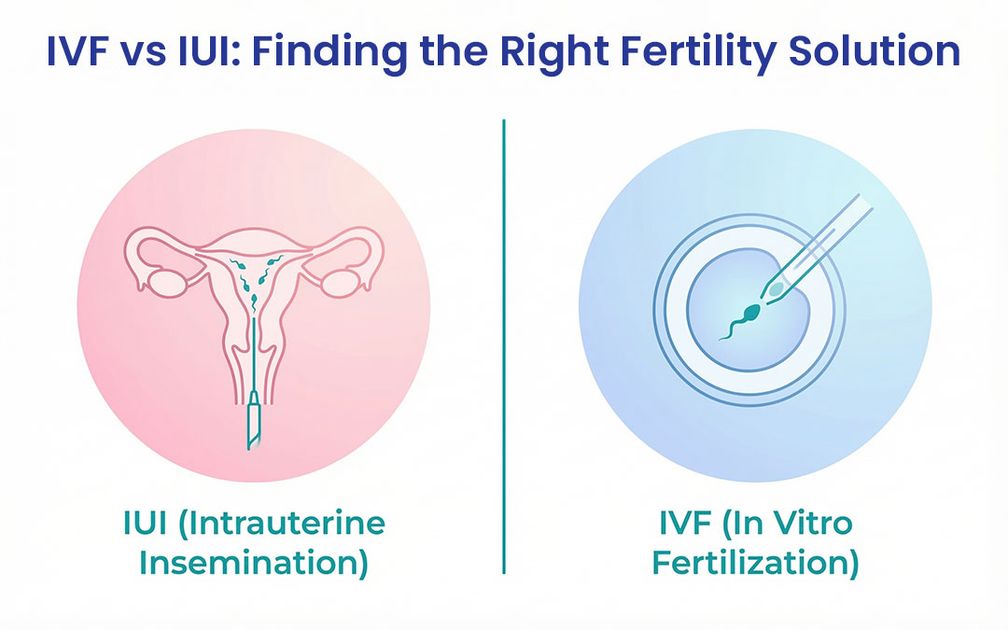
\Intrauterine insemination places washed, concentrated sperm directly into the uterus via a thin catheter at the time of ovulation. The procedure takes a few minutes and does not require anaesthesia.
The key word is "concentrated." In a natural cycle, sperm must travel from the vaginal canal through the cervix, across the uterine cavity, and into the fallopian tube where fertilisation occurs. Cervical mucus filters out most of the ejaculate along the way, and only a fraction of sperm ever reach the tube. IUI bypasses the cervix entirely and deposits sperm at the top of the uterine cavity, shortening the distance to the egg and increasing the number of motile sperm available at the site of fertilisation.
That is the entire mechanism. IUI gives sperm a head start. It does not change egg quality, does not influence whether a tube is open, does not help if fertilisation itself is the problem. The fallopian tube still needs to be functional because fertilisation occurs inside it. An embryo still needs to implant on its own.
This is why IUI works well for certain diagnoses and fails for others. Understanding that distinction is more useful than comparing headline success rates.
What Are the Real Success Rates for IUI?
A study published in Reproductive BioMedicine Online found IUI success rates of 13% per cycle for women under 35. With ovarian stimulation added, per-cycle rates reach 10 to 20% depending on age, sperm quality, and the cause of infertility. Cumulative rates across three to four medicated cycles climb to 20 to 40% for women under 35 with no significant anatomical or male factor issues.
Research also shows that 90% of IUI pregnancies occur within the first three attempts. After three to four failed cycles, the per-cycle success rate stops rising meaningfully, and continued IUIs begin to delay rather than approach the goal.
Age matters significantly. Between 35 and 37, success rates drop to 10-15% per cycle. Between 38 and 40, the rate falls to 8-10%. After 40, the picture changes sharply. Per-cycle IUI rates fall below 5%, and a 2024 analysis by Zhang and colleagues found cumulative live birth rates of just 6.9% across multiple IUI cycles for women in this age group. At that point, IUI is consuming time that matters.
One factor that is frequently underweighted in clinic conversations is total motile sperm count after washing. Post-wash total motile sperm count (TMSC) below 5 million significantly reduces IUI success rates. The procedure depends on an adequate number of sperm reaching the tube. When they do not, IUI fails for the same reason natural conception does, just from a slightly closer starting point.
How Does IVF Work Differently?
IVF removes the fertilisation process entirely from the body. Eggs are retrieved from the ovaries under sedation, fertilised in an embryology laboratory, cultured for three to five days to blastocyst stage, and the resulting embryo is transferred into the uterus. The fallopian tubes play no role at any stage.
This single difference explains most of the clinical scenarios where IVF succeeds after IUI has failed. If a tube is blocked or absent, IUI cannot work because sperm cannot reach the egg. IVF routes around the tube completely. If sperm quality is poor enough that natural fertilisation is unlikely even in the uterine cavity, ICSI during IVF injects a single sperm directly into each egg in the laboratory. If the embryo itself is the problem due to chromosomal abnormality, PGT-A testing of embryos before transfer allows selection of only chromosomally normal ones for transfer, something IUI cannot approach.
IVF also provides information. A cycle that reaches retrieval and culture reveals whether fertilisation is occurring, how many embryos develop, and the quality of those embryos. Couples who have had multiple failed IUI cycles often learn more diagnostically from one IVF cycle than from six months of earlier treatment.
What Does IVF Success Look Like Compared to IUI?
Per-cycle live birth rates for IVF are significantly higher than IUI across all age groups, but the difference is most pronounced under 35.
- For women under 35, IVF live birth rates per cycle sit between 40 and 55% at leading centres, against IUI's 10 to 20%.
- Between 35 and 37, IVF delivers around 32% per cycle, roughly double the IUI rate for the same age group.
- For women over 40, IVF live birth rates fall to approximately 10 to 20% per cycle using own eggs, but this still represents two to four times the per-cycle success of IUI, which drops below 5% at the same age.
The higher per-cycle success rate of IVF means fewer overall cycles are typically needed to achieve a live birth. A couple who spends four months on three IUI cycles at 12% each, then transitions to IVF, has a lower cumulative probability over that total period than a couple who begins IVF directly. It is not a hypothetical argument.
A cost-effectiveness analysis published in BMC Health Services Research found that for couples with unexplained infertility and mild male factor, a primary offer of one full IVF cycle was both cheaper per live birth and more cost-effective than starting with IUI followed by IVF, because IUI followed by IVF costs more in total while producing fewer live births per unit of time.
Which Conditions Make IUI the Right Starting Point?
IUI is appropriate and evidence-supported in a defined set of clinical circumstances. The 2023 ESHRE guideline on unexplained infertility recommends IUI with ovarian stimulation as first-line treatment, citing lower invasiveness, lower cost, and acceptable outcomes for appropriately selected patients.
Both ASRM and ESHRE guidelines support IUI-OS as a reasonable first-line approach, a position that contrasts with the UK's NICE guidance, which recommends IVF as first-line for unexplained infertility. The debate remains genuinely unresolved in the clinical literature.
IUI is most appropriate for:
- Mild male factor infertility, where post-wash total motile sperm count falls between 5 and 20 million. Below 5 million, IUI success rates drop sharply enough that IVF with ICSI is the more evidence-supported first step.
- Unexplained infertility in women under 38 with patent fallopian tubes and normal ovarian reserve, where ESHRE guidelines support IUI-OS as first-line and where the patient's age does not make the delay of three to four IUI cycles clinically costly.
- Cervical factor infertility, where hostile cervical mucus impairs sperm transit. IUI bypasses the cervix entirely, which removes this barrier completely.
- Donor sperm cycles for single women and same-sex couples, where IUI is typically the first-line approach unless specific clinical factors indicate otherwise.
- Couples with PCOS-related anovulation responding well to letrozole or clomiphene, where monitored stimulation combined with IUI often produces good results at low cost.
When Does IVF Become the Right Choice First?
The clinical conditions that make IVF the appropriate first choice rather than a fallback after failed IUI are well defined.
- Tubal damage or absence is the clearest one. If one or both fallopian tubes are blocked, damaged by endometriosis, or absent due to previous surgery, IUI has no biological pathway to success. IVF is the only option that bypasses this anatomy.
- Significant male factor infertility, where post-wash TMSC falls below 5 million or sperm DNA fragmentation index exceeds 30%, produces consistently poor IUI outcomes. ICSI during IVF addresses fertilisation failure that IUI cannot.
- Women aged 38 and over with unexplained infertility sit at a point where the time cost of three to four IUI cycles carries real clinical weight. A 2024 literature review concluded that IVF should be offered first-line to women with unexplained infertility aged 38 and above, reserving IUI-OS for younger women with good prognosis.
- Moderate to severe endometriosis impairs IUI outcomes through distorted pelvic anatomy and inflammatory changes that affect egg and embryo quality. IVF, combined with careful stimulation and PGT-A testing of embryos where appropriate, is the more effective path.
- Low ovarian reserve, defined by AMH below approximately 1.1 ng/mL or an antral follicle count below 7, indicates a limited egg supply. Each IUI cycle that does not result in pregnancy consumes time and ovarian cycles that may not be replaced. IVF with optimised stimulation protocols makes fuller use of a diminishing resource.
What Do Costs Look Like and How Should Couples Think About Them?
IUI costs much less than IVF per treatment cycle.
In the United States:
- One IUI cycle usually costs between USD 300 and USD 1,000, excluding medications.
- Fertility medications can add another USD 500 to USD 3,000 depending on the treatment plan.
IVF is significantly more expensive:
- A standard IVF cycle in the US typically costs USD 12,000 to USD 15,000.
- Additional procedures, such as PGT-A testing or ICSI, can further increase the total cost.
At first glance, IUI appears more affordable. However, the overall cost can increase if multiple IUI cycles fail before moving to IVF.
For example:
- Three medicated IUI cycles at USD 2,000 each total around USD 6,000.
- If IVF becomes necessary later, the total treatment cost may range from USD 18,000 to USD 21,000.
In some cases, starting with IVF may reduce both treatment time and total spending, especially when IVF is already the medically appropriate option.
For international patients, the cost difference becomes even more important:
- IVF in India usually costs between USD 2,500 and USD 4,500 per cycle.
- In Spain and the Czech Republic, costs generally range from EUR 3,500 to EUR 5,000.
At these prices, many patients over 35 choose IVF earlier instead of spending time and money on multiple unsuccessful IUI cycles.
What Questions Should Couples Ask Before Deciding?
- After semen analysis and washing, what is the total motile sperm count, and does it meet the threshold where IUI is likely to be productive?
- Are both fallopian tubes confirmed patent on hysterosalpingography (HSG) or saline infusion sonography, and is the uterine cavity normal on assessment?
- What is the AMH level and antral follicle count, and does the ovarian reserve support the time investment of multiple IUI cycles?
- If unexplained infertility is the diagnosis, how does the treating specialist weigh the ESHRE and NICE guidelines in the context of age and reproductive history?
- What is the clinic's policy on monitoring and cancelling stimulated IUI cycles when three or more follicles develop, given the multiple pregnancy risk?
- If IUI fails after three cycles, what is the transition pathway, and how will that delay factor into the overall treatment plan?
To Conclude
IUI and IVF are not the same treatment at different price points. They work through different mechanisms, and they fail for different reasons. The choice between them is not a question of boldness or budget. It is a clinical question about which biological barrier is preventing conception.
For couples where the barrier is sperm reaching the egg, and the tubes are open, IUI is a reasonable, guideline-supported starting point. For couples where the tube is the problem, where sperm quality makes fertilisation unlikely, or where age makes delay costly, IVF is not the aggressive option. It is the appropriate one.
The most expensive treatment is the wrong one, regardless of the price on the invoice.
Take the Next Step
Choosing between fertility treatments should begin with a proper medical evaluation, not guesswork. Tests such as semen analysis, AMH testing, antral follicle count, and fallopian tube assessment help doctors identify which treatment option is most appropriate for each couple.
For patients considering treatment abroad, understanding the expected success rates, total costs, travel requirements, and clinic regulations is equally important.
At Qonaq Health, our experts help patients compare fertility treatment options across leading international destinations, including India, Turkey, Thailand, and other established medical tourism hubs. We guide couples through clinic selection, treatment planning, estimated costs, and the practical aspects of travelling for fertility care so they can make informed decisions with greater clarity.
Disclaimer: This article provides general educational information about IUI and IVF as fertility treatments. It does not constitute medical advice and must not replace a consultation with a qualified reproductive endocrinologist or fertility specialist. Individual treatment decisions depend on diagnosis, age, ovarian reserve, sperm parameters, and clinical history. Couples should consult a fertility specialist before making any treatment decisions.
Related Hospitals
Discover hospitals and medical centers related to this topic for quality healthcare services.

Medical Park Bahcelievler Hospital
Medical Park Bahcelievler Hospital is a 242-bed JCI-accredited hospital in Istanbul, established in 2007. Spread across 33,000 square meters and 19 fl...
Accreditations

Facilities

BLK-Max Super Speciality Hospital, New Delhi
BLK-Max Super Speciality Hospital in New Delhi is one of India's premier healthcare institutions, offering 650 beds, 22 advanced operation theatres, a...
Accreditations


Facilities

Fortis Memorial Research Institute (FMRI), Gurgaon
Fortis Memorial Research Institute (FMRI), Gurgaon, is a world-class multi-specialty hospital established in 2013. The hospital offers 330 beds, 15 op...
Accreditations


Facilities

Artemis Hospital, Gurgaon
Artemis Hospital, Gurgaon, is a JCI accredited multispecialty hospital that was established in 2007. It offers 750+ beds and world -class infrastructu...
Accreditations



Facilities

Kokilaben Dhirubhai Ambani Hospital, Mumbai
Kokilaben Dhirubhai Ambani Hospital, Mumbai, is a JCI, NABH, NABL, and CAP-accredited quaternary care hospital established in 2009. With 750 beds, 180...
Accreditations


Facilities

Medicover Hospitals, Hitech City, Hyderabad
Medicover Hospitals, Hitech City, Hyderabad, is a 400-bed NABH-accredited super-specialty hospital established in 2011. It is part of Medicover, a glo...
Accreditations


Facilities
Related Doctors
Connect with experienced doctors and medical specialists in this field.

Dr. Radhamony D
Senior Consultant

Dr. Sushma Prasad Sinha
Senior Consultant

Dr. Suresh Kumar Rawat
Senior Consultant

Dr. Rupali Goyal
Senior Consultant

Dr. Sohani Verma
Senior Consultant
Related Articles
Explore more articles and insights on similar health topics.

Tummy Tuck Surgery in India: Cost, Recovery, Techniques, and Results
Breast Reconstruction After Breast Cancer Surgery

Rhinoplasty in India: Cost, New Techniques, and Recovery

Why IVF Fails: Common Causes and What to Do Next

Egg Freezing Abroad: Best Countries, Costs, and What to Expect
IVF Success Rates in India: What Couples Should Know in 2026

Our website uses cookies. By clicking on accept you give your consent to the use of cookies as per our Privacy Policy.
